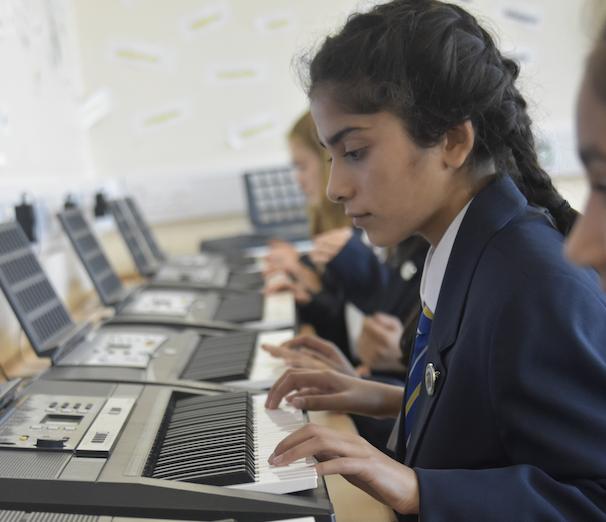
Music is delivered to students through two one-hour lessons over the two week timetable. At KS3 the students learn to listen to and appraise music, perform solo and as part of an ensemble and compose their own music. The techniques needed for further study at GCSE are embedded into the KS3 schemes of study.
Year 7
Autumn Term
Kpanlogo
As the introduction to music at Lordswood this unit focuses on rhythm and pulse, using 4 beats. It teaches students the basics of counting musically, using percussion, drums and singing. This in turn will develop their vocal skills. This first unit will introduce students to both rehearsal and performance, as well as peer and self feedback and how it can be used to improve their own creations.
Spring Term
African Music and Minimalism
In this unit students will be introduced to African drumming in order to build on the skills taught in the previous half term on rhythm and pulse. Through the integrated activities of performing, composing and listening, pupils will gain an understanding of how African music is composed and fits into the wider culture of West African society. Students will also continue to develop their own musical skills and understanding with a focus on internal pulse, ensemble playing and drumming technique. Students will also learn about alternative notations used in African drumming.
Summer Term
Pop Music Performance
Students will be introduced to the origins of Pop music. They will study different styles and rehearse and prepare their own songs for performance. They will consolidate the performance and feedback skills they have been developing throughout year 7 and share their work regularly with the class. The year will end with a recorded performance to the class as an audience.
Year 8
Autumn Term
Blues and Jazz
This scheme has cross-curricular links with the history of the music. Students will explore the origins of the music and study various pieces in these genres. Students will learn to play the 1/4/5 chord and be introduced to the Blues scale, experimenting with musical improvisation techniques. Students will be assessed in pairs and small groups playing the chords and improvising their own variations.
Spring Term
Reggae and Samba
Students will learn the basic characteristics and history of Reggae and Samba music. They will be introduced to keyboard and ukulele skills to support this work. Students will rehearse and perform regularly to each other, including the use of percussion instruments. They will rehearse and perform both a samba and reggae song and critique these with their peers.
Summer Term
Fanfares
This unit begins by exploring the history, origins and various uses of Fanfares. Students learn about the Harmonic Series, using this to perform a traditional military Fanfare – “The Last Post”. Throughout the unit, students listen and respond to a variety of fanfares from different times and places. Students explore the concept of musical imitation and how this often features in Fanfares, performing and listening to different Fanfares which use this device. Finally, students will respond to a commission to write a Fanfare. They will consider factors which affect composers’ responses to a commission.
Year 9
Autumn Term
Film music
Students will explore the techniques of different film composers. They will explore a range of genres (action, horror, Mission Impossible), analysing the key features of each and applying these to their own work. They will work in pairs to develop sequences on the keyboard and other instruments. There is a choice of assessment where students can pick one clip to focus on for their final performance.
Spring Term
Music Production
Students will explore the role of a producer in music. They will explore music composition and production. Students will use the Digital Audio Workstations to manipulate sounds/samples and arrange them to produce a musical outcome. Bandlab and garageband will be used for this purpose. They will explore the process involved in music production and apply this to their own piece, using technology to enhance the music created.
Summer Term
Introduction to Songwriting
Students will explore an overview of the songwriting process and discuss the elements involved. An introduction to basic music theory will be covered in preparation for those students wishing to take GCSE Music. Students will analyse popular songs, exploring their structure and different elements. They will study different chord progressions in order to enhance their own work. Students will work in small groups and individually to rehearse and create their own songs for an audience.
Assessment at Key stage 3
All students complete a baseline assessment at the start of each year to assess entry level. Students regularly reflect on their work. Final performances are recorded and both teacher and peer assessment is undertaken throughout the composition and rehearsal process. Whole class feedback and individual assessment feedback is provided in student booklets which track progress across the year.
How can parents help support their child’s learning?
BBC Bitesize is an excellent resource. Useful resources are provided in google classrooms. Bandlab.org is popular for creating music without needing to purchase specialist software.
Enrichment opportunities
Instrumental lessons are offered for guitar, brass, woodwind, strings, drums, voice and piano. Individual and performing ensembles are offered by Services for Education and independent teachers. Keyboard club is offered to Year 7 and 8 students Monday lunchtimes. Rehearsal and performance clubs run at lunchtimes and Thursday after school to prepare students to participate in the Christmas concert and whole school musical that takes place in July.